



Writing a Studio Dancewear Policy That Families Will Actually Follow
Every studio director has spent time on dress code enforcement that they would rather have spent teaching. A dancer arrives in the wrong color, a parent argues that the requirement was never clearly stated, and the conversation eats into class time that was already tight. Most of these situations trace back to a policy written quickly and never revisited. A well-constructed dancewear policy prevents nearly all of them, and building one properly takes a single afternoon that pays back across an entire season.
The problem is rarely defiance. It is usually ambiguity.
What a Dress Code Is Actually For
Before writing anything, be clear on the purpose, because the purpose determines how strict each element needs to be.
The legitimate reasons are visibility of line and alignment for correction, safety in movement, consistency that reduces comparison among students, and preparation for professional environments where codes are standard.
The reasons that do not hold up are habit and aesthetic preference unconnected to instruction. Every requirement in a code should trace to one of the legitimate purposes. Anything that cannot be justified that way will generate friction disproportionate to its value, and it is worth cutting.
Separate Requirements by Class Type
A single studio-wide code applied uniformly across every class is the most common structural mistake.
Ballet technique has genuine instructional reasons for a fitted silhouette and a restricted palette, because an instructor needs to see the body clearly to correct alignment. Contemporary, jazz, hip hop, and commercial classes generally do not carry the same requirement, and applying ballet standards to them creates rules students perceive as arbitrary.
Write the code by class rather than by studio. State plainly which classes are strict and which are open. Students follow rules they understand the reason for, and they resist rules that appear to exist for no reason.
Write in Specifics, Not Adjectives
Ambiguity is where enforcement problems originate. Compare two versions of the same requirement.
Vague: appropriate fitted dancewear in a solid color, hair neatly secured.
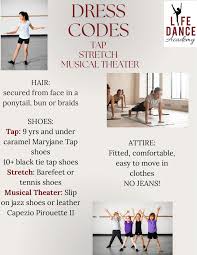
Specific: black leotard, any neckline or strap style. Pink or black convertible tights. Black shorts permitted over the leotard. Hair in a secured bun, no loose ends.
The second version cannot be misread, and it removes the parent’s reasonable objection that they did not know. It also removes the instructor from the position of making judgment calls about what counts as appropriate, which is a conversation nobody wants to have with a fourteen-year-old.
Include what is permitted, not only what is prohibited. A code listing only restrictions leaves families guessing at the boundaries.
Build In Coverage Options
This matters most for dancers in adolescence, and building it into the written code is far better than handling it case by case.
Explicitly permitting shorts or briefs over a leotard, and permitting higher necklines and backs within the required color, costs nothing instructionally. A dancer’s alignment remains fully visible in a high-back leotard.
Dancers who feel exposed in a mirrored room manage that discomfort during class, and the attention comes out of their training. Writing the options into the code means no student has to ask for an exception, which is a request many will simply not make.
Account for Cost
A code that requires many specific items creates real financial pressure, and families rarely raise it directly. They just fall out of compliance or leave.
Keep the required list short. Distinguish clearly between requirements and recommendations. Permit any brand unless there is a genuine reason not to. If the studio requires a specific item for performances, state the cost upfront at registration rather than mid-season.
Consider whether a color requirement can span a range rather than a single exact shade, since exact-match requirements force purchases that a broader range would not.
Communicate It Before the Season, Not During
Send the code in writing at registration, before families have bought anything. Include it in the enrollment packet, post it on the site, and email it again two weeks before classes begin.
Include measurement guidance if possible, particularly torso length, which is the measurement most responsible for poor fit and returns. Families who buy correctly the first time do not arrive in the wrong thing.
If the code changes, announce it a full season ahead. Mid-year changes that require new purchases generate more resentment than any other policy decision a studio makes.
Enforce Consistently or Not at All
A code enforced selectively is worse than no code, because it reads as favoritism and undermines every other rule.
Decide what the response to non-compliance actually is, communicate it, and apply it evenly. If the studio is not prepared to enforce a requirement, remove it from the code rather than leaving it as a rule that only sometimes applies.
Building Your Policy
Tie every requirement to an instructional reason, write by class type, use specifics rather than adjectives, build in coverage, and communicate before families spend money. Tiger Friday works with studios and coaches outfitting dancers across all of these categories. Explore the range to see what fits your program’s requirements.