


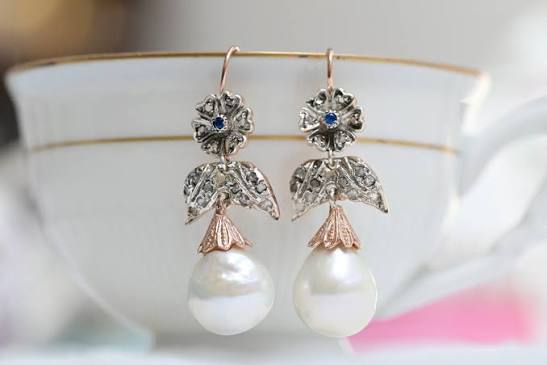
A Bride’s Guide to Antique Wedding Earrings by Era
There is a quality in period jewelry that contemporary pieces rarely replicate, and it is not simply age. Older stones were cut by hand to catch candlelight rather than spotlights, which gives them a softer, more variable return of light. Metalwork from certain decades was executed at a level of fineness that modern production economics no longer support. For a bride considering antique wedding earrings, understanding what distinguishes each period turns an overwhelming category into a set of clear choices.
Each era has a recognizable signature, and each suits a different bride.
Victorian: Warmth and Sentiment
Victorian jewelry spans roughly the 1830s through the turn of the century, and it changed considerably across those decades. What unites the period is warmth. Yellow gold dominates, often in higher karats than are common today, giving pieces a rich, slightly buttery color.
Look for seed pearls, rose-cut diamonds, and colored stones including garnet, amethyst, and turquoise. Motifs frequently carry meaning, since the Victorians embedded sentiment in nearly everything they made.
These suit a bride wanting softness rather than sparkle, and they pair particularly well with warm-toned gowns in ivory or champagne rather than stark white.
Edwardian: Lace in Platinum
The Edwardian period, roughly 1901 through the First World War, coincided with the technical ability to work platinum at scale. The result was jewelry of remarkable delicacy.
Milgrain edging, filigree, and openwork produce pieces that genuinely resemble lace rendered in metal. Diamonds and pearls dominate, and the overall effect is light, airy, and almost weightless in appearance.
For bridal purposes this era is often the easiest to wear. The palette is white on white, the scale tends toward the refined rather than the dramatic, and the aesthetic reads as timeless in photographs decades later.
Art Deco: Geometry and Contrast
The 1920s and 1930s brought a decisive break. Symmetry, strong lines, and bold contrast replaced the softness that preceded them.
Expect calibrated cut colored stones set against diamonds, geometric drops, and architectural forms. Onyx, sapphire, and emerald appear frequently as accent stones. The period produced some of the most striking earrings ever made for evening wear.
This era suits a bride with a clean, structured gown, particularly anything with strong shoulders or a column silhouette. The jewelry provides the visual interest, so the dress can stay simple.
Retro: Bold Gold and Sculptural Volume
The 1940s pushed toward volume and warmth again, partly because platinum was restricted for wartime use. Rose and yellow gold return, forms become sculptural, and scale increases.
Retro pieces read as confident rather than delicate. They work well for a bride who wants jewelry that registers clearly at a distance, and they photograph strongly.
Reading the Stones
Older diamonds were cut to different priorities than modern stones. Old mine cuts and old European cuts have smaller tables, higher crowns, and larger culets, which produces broader flashes of light rather than the fine scintillation of a modern brilliant. Rose cuts, with flat backs and faceted domes, give a subtle glow instead of fire.
None of these is inferior. They simply behave differently, and many buyers prefer the character once they have seen it in person under warm light rather than under retail lighting.
Condition and Wearability Checks
A wedding day involves many hours of wear, so condition matters as much as beauty.
Ask about the earring backs. Many antique earrings were made with screwbacks or shepherd hooks, and screwbacks in particular can be uncomfortable over a long day. Reputable dealers frequently convert them to posts, which is a common and accepted practice. Confirm whether a conversion has been done or is available.
Ask whether stones have been checked for security and whether any prongs have been retipped. Ask about repairs and replacements, since an honest dealer will disclose them and the disclosure is a good sign rather than a bad one.
For drop styles, consider weight. Anything substantial will be felt by hour eight.
Matching the Piece to the Gown
Neckline and hairstyle govern the choice more than the dress fabric does. Hair worn up leaves the ear fully visible and supports a drop or a chandelier form. Hair worn down favors something with vertical presence that will not disappear.
A high or embellished neckline generally calls for restraint at the ear. A strapless or simple neckline leaves room for scale.
Finding the Right Piece
Antique earrings carry something a new piece cannot manufacture, which is history that predates the wedding and will continue after it. Identify the era that matches your gown and your temperament, learn to read the stone cutting, and confirm condition and comfort before committing.
For brides ready to begin looking, Gesner Estate Jewelry specializes in period pieces across all of these eras, with the provenance and condition detail that a purchase of this kind deserves. Visit the site to explore what is currently available.