



When you’re shipping fragile products, moving household items, or protecting inventory in storage, the right cushioning material can make the difference between a safe delivery and a costly damaged item. StarBoxes bubble rolls come in different bubble sizes and specialty options, making it easier to match protection to the item you’re packing. The key is understanding bubble size, thickness, roll width, length, and the level of protection your product actually needs.
This guide explains how bubble roll works, which size to choose, how thickness affects protection, and how to use it effectively for shipping and storage.
Key Highlights
- Small 3/16-inch bubble: Best suited to smaller, lightweight and delicate items.
- Medium 5/16-inch bubble: A versatile option for medium-sized items requiring additional cushioning.
- Large 1/2-inch bubble: Provides substantial cushioning for larger items, heavier products and void filling.
- Specialty bubble rolls: Anti-static, kraft-backed, colored and insulated options address specific packaging requirements.
- Roll width matters: Choose a width that allows you to completely cover the item without excessive material waste.
- More bubble isn’t always better: The right size depends on the item’s weight, fragility, shape and shipping conditions.
What Is Bubble Roll Packaging?
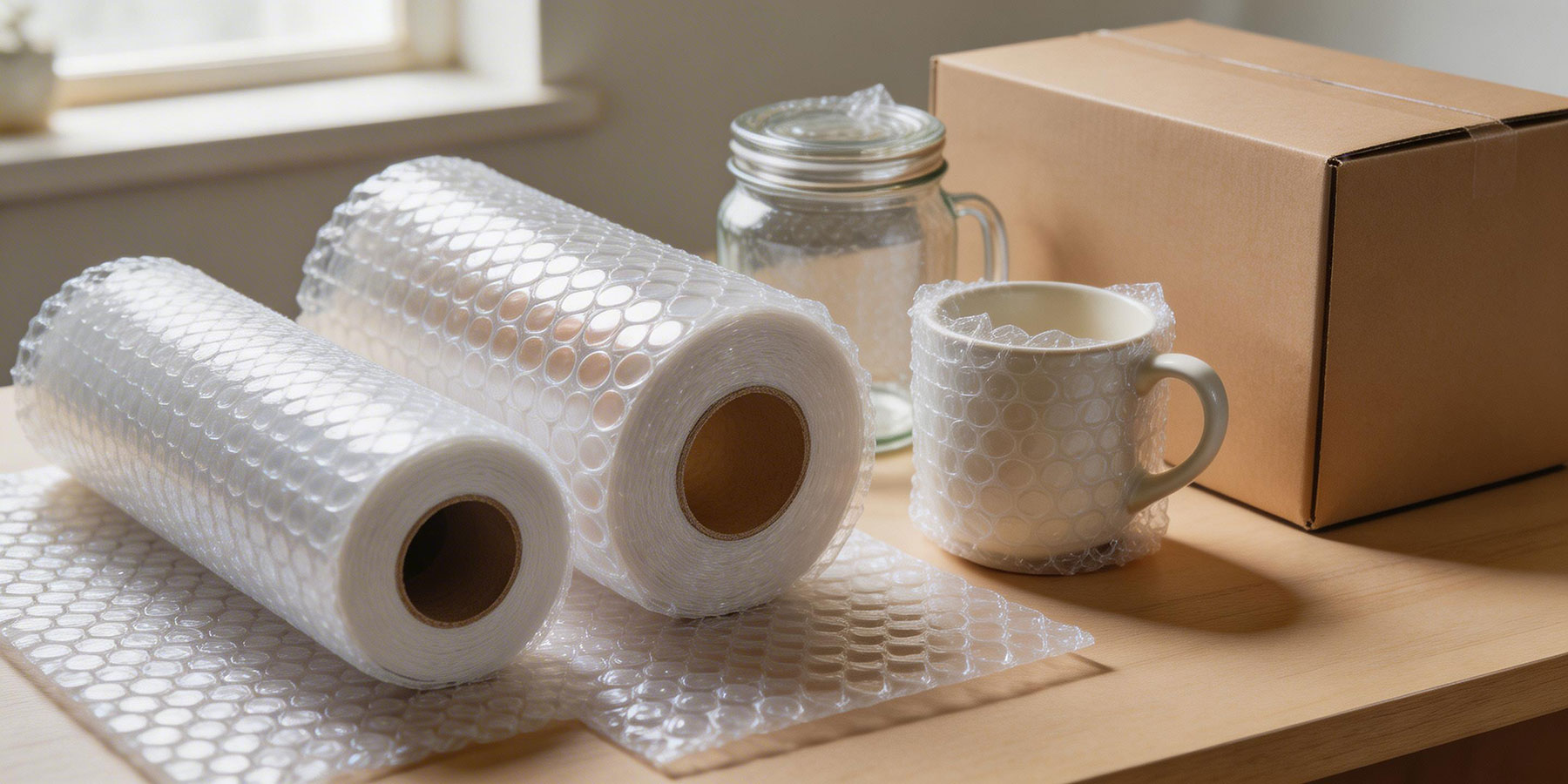
Bubble roll, commonly called bubble wrap, is a flexible cushioning material containing air-filled pockets. These pockets help absorb impacts and reduce the effects of vibration, pressure and movement during handling and transportation.
Bubble roll can be used for:
- Shipping fragile products
- Protecting glassware and ceramics
- Packing electronics
- Wrapping artwork and mirrors
- Moving household goods
- Protecting furniture and decorative items
- Filling empty spaces inside boxes
- Protecting products during storage
Because bubble roll is lightweight and flexible, it can conform to products with different shapes without adding significant packaging weight. It can also be combined with boxes, packing paper and other protective materials for additional cushioning.
Why Choosing the Right Bubble Roll Size Matters
A common mistake is assuming that the largest bubble provides the best protection for every product. That’s not necessarily the case.
Bubble rolls are manufactured with different bubble heights, and each size is suited to different applications. StarBoxes currently categorizes its standard bubble rolls into small 3/16-inch, medium 5/16-inch and large 1/2-inch options, along with specialty varieties.
Using a bubble that’s too small can leave heavier items insufficiently cushioned. On the other hand, using oversized bubbles on tiny products can take up unnecessary space and increase packaging material usage.
The goal is to create enough cushioning to protect the product while keeping the package practical and efficient.
Bubble Roll Size Comparison
| Bubble Size | Best For | Typical Applications |
| 3/16-inch Small Bubble | Small, lightweight and delicate products | Glassware, dishes, figurines, small electronics |
| 5/16-inch Medium Bubble | Medium-sized products requiring additional cushioning | Artwork, mirrors, appliances, electronics |
| 1/2-inch Large Bubble | Large, bulky or heavier products | Furniture, large mirrors, artwork, void filling |
| Anti-Static Bubble | Electronics and static-sensitive products | Computers, phones, electronic components |
| Kraft-Backed Bubble | Larger products needing additional surface protection | Furniture, antiques and other large items |
| Insulated Bubble | Temperature-sensitive applications | Thermal protection and insulation |
These are general guidelines; the appropriate material ultimately depends on the product, packaging configuration and shipping conditions.
1. Small Bubble Roll: 3/16 Inch
Small bubble roll is a practical choice for lightweight and delicate products that need protection from scratches, minor impacts and abrasion.
It’s commonly used for:
- Glassware
- China and porcelain
- Figurines
- Small decorative objects
- Small electronics
- Jewelry and trinkets
- Household accessories
The smaller air pockets provide relatively compact cushioning, making this option useful when you want protection without adding excessive package volume.
For particularly delicate items, multiple layers can provide additional cushioning.
When should you choose small bubble roll?
Choose it when the product is:
- Relatively lightweight
- Small or compact
- Fragile
- Sensitive to scratches or surface damage
- Easy to wrap closely
For example, a set of ceramic mugs may benefit from small bubble roll wrapped individually before being placed inside a properly sized shipping box.
2. Medium Bubble Roll: 5/16 Inch
Medium bubble roll provides a balance between compact cushioning and increased impact protection.
The 5/16-inch bubble is commonly used for products such as:
- Artwork
- Mirrors
- Medium-sized appliances
- Electronics
- Home décor
- Larger dishes
- Decorative objects
It’s particularly useful when small bubble cushioning doesn’t provide enough separation or impact absorption but large bubble cushioning would be excessive.
When should you choose medium bubble roll?
Medium bubble roll is a good starting point when you’re packing products that are:
- Medium-sized
- Moderately heavy
- Vulnerable to impact
- Larger than typical household fragile items
- Likely to experience movement during transit
It can also be used as void fill to help limit movement inside a shipping box.
3. Large Bubble Roll: 1/2 Inch
Large bubble roll provides more substantial cushioning and is particularly useful for large, bulky or heavier products.
Common applications include:
- Furniture
- Large mirrors
- Artwork
- Glass cabinet doors
- Tabletops
- Large decorative items
- Large electronics
- Void filling
The larger air pockets can help absorb impacts and create separation between the product and the surrounding packaging.
When should you choose large bubble roll?
Consider large bubble roll when the product:
- Is large or bulky
- Has a relatively large surface area
- Needs additional cushioning
- Is vulnerable to drops or impacts
- Requires void filling inside a larger box
Large bubble roll is also useful when you need to prevent a product from shifting within its packaging.
What Does Bubble Roll “Thickness” Actually Mean?
One important point about bubble roll terminology is that the measurement generally refers to the height of the bubble, rather than simply describing the overall plastic film thickness.
For example:
- Small bubble: approximately 3/16 inch
- Medium bubble: approximately 5/16 inch
- Large bubble: approximately 1/2 inch
StarBoxes explains that these measurements indicate the bubble height, which influences the cushioning provided to the packaged product.
This distinction matters because two bubble rolls can have different bubble dimensions and therefore provide different cushioning characteristics.
When comparing products, don’t look only at the roll’s overall appearance. Consider the bubble size and the product you’re trying to protect.
How to Choose Bubble Roll Thickness for Your Product
Instead of asking, “What is the thickest bubble roll I can buy?” ask:
“What level of cushioning does my product actually need?”
Use this simple approach:
Lightweight and delicate products
Start with small bubble roll.
Examples:
- Glassware
- Porcelain
- Small décor
- Small electronics
Medium-sized products
Consider medium bubble roll.
Examples:
- Artwork
- Mirrors
- Medium appliances
- Larger electronics
Large or heavier products
Consider large bubble roll.
Examples:
- Furniture
- Large decorative pieces
- Large mirrors
- Bulky items
For especially valuable or fragile products, you may combine different bubble sizes or use additional protective materials. StarBoxes specifically recommends using multiple bubble sizes in some packing situations—for example, smaller bubbles around the product and larger bubbles around it inside the box.
How to Choose the Right Bubble Roll Width
Bubble size isn’t the only measurement that matters.
The width of the roll determines how easily you can wrap the product.
Common widths include:
- 12 inches
- 24 inches
- 48 inches
StarBoxes offers these widths across various bubble-roll options.
12-inch rolls
A narrower roll can work well for smaller products and individual household items.
24-inch rolls
A wider option can make wrapping medium-sized products such as artwork, electronics and mirrors easier.
48-inch rolls
Wide rolls are useful for large products and larger surface areas where a narrow roll would require multiple pieces.
A simple rule
Measure the item before purchasing the roll.
You want enough width to cover the product completely while leaving enough material to overlap and secure the wrapping.
How Much Bubble Roll Do You Need?
The amount you need depends on:
- Product dimensions
- Number of products
- Number of protective layers
- Bubble size
- Wrapping method
- Whether you’re using bubble roll as void fill
For occasional packing, smaller rolls may be convenient.
For businesses shipping hundreds or thousands of products, longer rolls can improve packing efficiency and reduce the need to frequently replace packaging material.
StarBoxes offers bubble rolls in different lengths and widths for both personal and business applications.
Tip for businesses
Track how much bubble roll your packing team uses per shipment. This can help you estimate monthly requirements and determine whether buying larger rolls or bulk quantities makes financial sense.
Which Side of Bubble Roll Goes Against the Product?
For standard wrapping applications, the bubble side should generally face the item so the air-filled pockets provide cushioning between the product and the outside packaging.
The smooth side faces outward.
Once wrapped, secure the ends with packaging tape so the material doesn’t loosen during handling. StarBoxes also recommends taping the ends for more secure packaging.
How to Pack an Item With Bubble Roll
Follow these basic steps for effective cushioning.
Step 1: Clean and prepare the product
Remove dust, dirt or loose parts before wrapping.
For products that can scratch easily, consider adding an appropriate soft protective layer before applying bubble roll.
Step 2: Measure the product
Measure its length, width and height.
This helps you determine how much bubble roll you need.
Step 3: Select the appropriate bubble size
Match the bubble size to the product’s dimensions, weight and fragility.
Step 4: Wrap the item completely
Cover all vulnerable surfaces and edges.
For fragile items, use enough material to provide a meaningful cushioning layer.
Step 5: Secure the wrapping
Use packing tape to keep the bubble roll in position.
Avoid placing excessive tape directly on delicate product surfaces.
Step 6: Place the item inside a suitable box
Choose a shipping box that provides enough room for the wrapped product and additional cushioning.
Step 7: Fill empty spaces
If the item can move around inside the box, add appropriate void fill.
The package should limit movement without compressing the product excessively.
Step 8: Perform the shake test
Gently shake the closed package.
If the product moves noticeably inside, add additional cushioning or void fill.
This is especially important because movement inside a box can increase the risk of damage during handling.
Should You Use One Layer or Multiple Layers?
There isn’t one universal number of layers for every product.
The appropriate amount depends on:
- Product fragility
- Product weight
- Bubble size
- Shipping distance
- Box strength
- Handling conditions
- Value of the item
For delicate products, multiple layers of small bubble cushioning can provide additional protection. For larger products, combining different bubble sizes can be more effective than simply adding many layers of one material.
The objective is to create a protective cushion—not simply to use as much bubble wrap as possible.
Specialty Bubble Rolls: When Standard Bubble Roll Isn’t Enough
Standard bubble roll works for many packaging applications, but specialized products can solve specific problems.
Anti-Static Bubble Roll
Electronics can be vulnerable to electrostatic discharge.
Anti-static bubble roll is designed for applications involving static-sensitive products such as:
- Phones
- Tablets
- Computer components
- Electronic devices
- Sensitive electrical components
If you’re shipping electronics, anti-static cushioning can provide protection that standard bubble roll doesn’t specifically address.
Kraft-Backed Bubble Roll
Kraft-backed bubble combines cushioning with a kraft paper exterior.
It can be useful for protecting larger products such as furniture and antiques while also providing a more durable protective surface. StarBoxes notes that its kraft-backed option also provides moisture resistance.
Colored Bubble Roll
Colored bubble cushioning can be useful when packaging presentation, product identification or branding matters.
Businesses can use different colors to distinguish product categories or create a recognizable packaging experience.
Insulated Bubble Roll
When temperature and heat transfer are concerns, insulated bubble products offer a different function from ordinary cushioning.
Insulated bubble rolls can provide thermal and moisture-barrier properties and are available in different widths for various applications.
Bubble Roll vs. Other Packaging Materials
Bubble roll isn’t always the only protective material you need.
| Packaging Material | Best Use |
| Small Bubble Roll | Small fragile items |
| Medium Bubble Roll | Medium-sized products |
| Large Bubble Roll | Large/heavy items and void filling |
| Packing Paper | Surface protection and void fill |
| Foam | Products requiring structured cushioning |
| Corrugated Boxes | Outer protection and structural support |
| Anti-Static Bubble | Electronics |
| Insulated Bubble | Temperature-sensitive applications |
For valuable or highly fragile products, combining materials can provide better protection than relying on bubble roll alone.
Common Bubble Roll Packaging Mistakes to Avoid
1. Choosing bubble size based only on price
The cheapest option isn’t necessarily the most cost-effective.
If inadequate protection causes product damage, returns and replacements can cost significantly more than the packaging material.
2. Using oversized bubbles for tiny products
Large bubbles can be unnecessary for small, lightweight items.
Small bubble cushioning may provide a more practical fit.
3. Leaving products exposed
Wrapping only the most obvious surfaces isn’t enough if the remaining edges or corners are vulnerable.
4. Ignoring movement inside the box
Even a perfectly wrapped item can be damaged if it moves excessively inside an oversized box.
5. Using standard bubble roll for static-sensitive electronics
Electronics may require anti-static protection rather than ordinary bubble cushioning.
6. Forgetting about roll width
Buying the correct bubble size but the wrong width can make packing slower and create unnecessary material waste.
7. Using bubble roll as the only protection
Bubble roll provides cushioning, but the outer shipping box still needs to provide appropriate structural protection.
How to Choose Bubble Roll for E-Commerce Shipping
E-commerce businesses have a particularly important packaging challenge: products may pass through multiple handling points before reaching the customer.
When choosing bubble roll for an e-commerce operation, consider:
Product value
Higher-value products may justify additional cushioning and packaging controls.
Product fragility
Glass, ceramics and electronics require more careful protection than durable products.
Product size
Match bubble size and roll width to the dimensions of the products you ship most frequently.
Shipping volume
High-volume operations can benefit from longer rolls and standardized packing procedures.
Return rate
Monitor damage-related returns. If damaged shipments are common, review whether the current packaging provides adequate cushioning.
Packing speed
Perforated bubble rolls can make dispensing and tearing easier. StarBoxes notes that its bubble rolls are perforated at regular intervals for easier use.
Bubble Roll Packaging Checklist
Before sealing a package, ask:
- Is the entire product adequately covered?
- Is the bubble size appropriate for the item’s weight and fragility?
- Are vulnerable corners protected?
- Is the bubble roll securely taped?
- Does the shipping box provide adequate room for cushioning?
- Is there excessive empty space?
- Can the product move inside the box?
- Does the item require anti-static protection?
- Does it need thermal or moisture protection?
- Is the outer box strong enough for the shipment?
Taking a few seconds to check these points can help prevent avoidable packaging failures.
Frequently Asked Questions
What size bubble roll is best for fragile items?
Small bubble roll is generally suitable for small, lightweight and delicate items such as glassware, porcelain and small electronics. For larger fragile products, medium or large bubbles may provide better cushioning.
Is 3/16-inch or 5/16-inch bubble roll better?
Neither is universally better. 3/16-inch is generally suited to smaller and lighter products, while 5/16-inch provides more cushioning for medium-sized items. Your choice should depend on the product’s size, weight and fragility.
When should I use 1/2-inch bubble roll?
Large 1/2-inch bubble roll is useful for larger or heavier products, larger surface areas and void filling. It can be particularly useful for items such as furniture, large mirrors and artwork.
Is thicker bubble roll always better?
No. The right bubble size depends on the product. Oversized bubbles may be unnecessary for small products, while undersized bubbles may not provide sufficient cushioning for larger or heavier items.
What bubble roll should I use for electronics?
For electronics that are sensitive to electrostatic discharge, use anti-static bubble roll rather than relying solely on standard bubble cushioning.
Can bubble roll be used as void fill?
Yes. Medium and large bubble rolls can help fill empty spaces and limit product movement inside a shipping box.
How do I calculate how much bubble roll I need?
Start with the dimensions of the products you’re wrapping, determine how many layers you need, and then account for the number of products being packed. For businesses, tracking actual usage per shipment can provide a more accurate estimate of ongoing requirements.
Final Thoughts
Choosing bubble roll isn’t simply about selecting the largest bubbles or the thickest-looking material. The right packaging solution matches the bubble size, roll dimensions and specialty features to the product being protected.
Small bubbles work well for delicate, lightweight products, medium bubbles provide versatile cushioning for a wide range of items, and large bubbles are useful for larger products and void filling. Specialty options such as anti-static, kraft-backed and insulated bubble rolls can address specific packaging challenges.
For businesses and individuals looking for a range of protective packaging options, Starboxes offers bubble rolls in multiple sizes, widths, lengths and specialty formats to accommodate different shipping, moving and storage requirements.