



How Does CPR Differ in an Unresponsive Adult Choking Victim?
Most people learn choking response and CPR as two separate procedures, taught in different sections of a2 coursed rehearsed independently. Real emergencies do n\\\\\\0-0-ot respect that separation. A conscious choking victim who is not cleared will lose consciousness, often within a few minutes, and the responder has to switch protocols mid-event under considerable stress. Understanding how does cpr differ in an unresponsive adult choking victim is what makes that switch automatic rather than a moment of hesitation, and hesitation is expensive here.
The differences are specific and worth knowing precisely.
Before Unresponsiveness: The Conscious Choking Response
While the person is still conscious and unable to speak, cough, or breathe, the response is abdominal thrusts, sometimes combined with back blows depending on the protocol you were trained under. The person will typically be upright, often clutching at the throat, and may still be attempting to cough.
Encourage coughing if any air movement is present, because a forceful cough generates more pressure than anything you can apply externally. Intervene when the cough becomes silent or stops.
The Transition Point
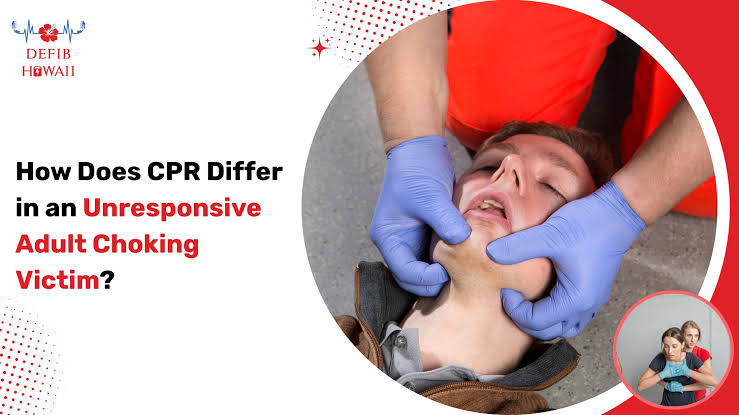
When the person goes limp and unresponsive, the entire approach changes. Lower them carefully to the floor rather than letting them fall, call for emergency services if that has not already happened, and begin CPR.
This is the part that surprises people. The instruction is to start chest compressions on someone whose problem is an airway obstruction rather than a cardiac event. It feels counterintuitive, which is exactly why it needs to be learned deliberately rather than reasoned out in the moment.
The Three Differences That Matter
Compared with standard CPR on an unresponsive adult, three things change.
Check the mouth before each set of breaths. Each time you open the airway to deliver breaths, look inside first. If you see an object, remove it. This visual check is the meaningful addition, and it is specific to a known or suspected obstruction.
Remove only what you can see. Sweep out a visible object with a finger. Never perform a blind finger sweep, meaning inserting a finger to search for something you have not seen. Blind sweeps push obstructions deeper and can injure the airway.
Expect resistance on the first breaths. If air will not go in, reposition the head and try again. Continued resistance confirms the obstruction is still present, which is useful information rather than a failure.
Beyond these, the sequence follows standard CPR. Compressions at the appropriate depth and rate, minimal interruptions, and continuation until the person recovers or trained help arrives.
Why Compressions Work on an Obstruction
The reason compressions are effective here is mechanical, and knowing it makes the guidance stick.
A chest compression raises pressure inside the chest cavity. That pressure has to go somewhere, and with the airway obstructed it pushes upward against the object from below. The effect is comparable to what abdominal thrusts accomplish on a conscious person, generated from a different direction.
Research examining airway pressures found that chest compressions can produce pressures at least as high as abdominal thrusts, which is a central reason the guidelines direct responders toward compressions once the person is unresponsive rather than continuing thrusts on the floor.
Compressions do double duty in this situation. They work on the obstruction and they circulate whatever oxygenated blood remains, which matters because an obstructed airway will progress to cardiac arrest if it is not resolved.
What Not to Do
Three errors recur.
Do not stop compressions to attempt more abdominal thrusts. Once the person is unresponsive and on the floor, compressions are the intervention.
Do not perform a blind finger sweep. This is worth repeating because instinct pushes strongly toward it.
Do not stop because the breaths are not going in. Resistance means the obstruction remains, which means continuing is exactly right. Reposition, attempt, and return to compressions.
After the Obstruction Clears
If the object comes out and the person begins breathing, place them in a recovery position and monitor closely until help arrives.
Medical evaluation is still necessary. Abdominal thrusts can cause internal injury, aspiration of material into the lungs is a genuine risk that may not present immediately, and a person who was without adequate oxygen for any meaningful period needs assessment. A recovered choking victim who feels fine should still be seen.
Learning the Sequence Properly
Reading through this builds understanding of what changes and why. Building the reflex to act without deliberating at the transition point takes supervised practice, and that gap is not something an article closes.
If you want to develop these skills reliably, Simple CPR offers training covering choking response, compressions, and the transitions between them. Visit the site to find a course suited to your role and schedule.